
DSP hardware vs. software EQ: what are the practical differences?
DSP hardware vs. software EQ: what are the practical differences?
Equalization has become essential in the world of modern headphones and hi-fi. Today, many users correct the frequency response of their headphones, compensate for their room's acoustics, or simply adjust their listening experience to their preferences.
But not all EQ solutions work the same way.
Two main approaches exist:
-
software EQ
-
hardware DSP integrated directly into the audio device
And in practice, the differences are often more significant than one might imagine.
Software EQ: flexible and extremely popular
Software EQ is currently the most widespread solution.
Examples include:
-
Equalizer APO
-
Peace
-
Roon DSP
-
Foobar2000
-
VST plugins
-
mobile applications
-
DSPs integrated into network players
The main advantage is obvious: flexibility.
Some solutions allow for:
-
dozens of parametric filters
-
FIR convolution
-
automatic correction
-
multiple profiles
-
advanced channel management
For an advanced user or a studio environment, this is extremely powerful.
Limitations of software EQ
However, software EQ also has several significant constraints.
Operating system dependency
A preset configured on Windows with Equalizer APO does not automatically work:
-
on macOS
-
on Linux
-
on a console
-
on a TV
-
on a network streamer
Equalization remains tied to the machine being used.
Complexity and maintenance
Depending on the software, it may sometimes be necessary to:
-
install specific drivers
-
manage multiple audio devices
-
verify that the DSP is active
-
maintain multiple profiles
-
resolve software conflicts
In some setups, this quickly becomes complicated.
Possible incompatibilities
Some audio software completely bypasses system EQ:
-
ASIO
-
exclusive WASAPI
-
mobile applications
-
consoles
-
hardware players
The result: EQ may work in some applications... then disappear in others.
Hardware DSP: equalization directly in the DAC
With hardware DSP, processing is integrated directly into the audio device itself.
Equalization is then applied:
-
independently of the operating system
-
without software running continuously
-
directly in the DAC or amplifier
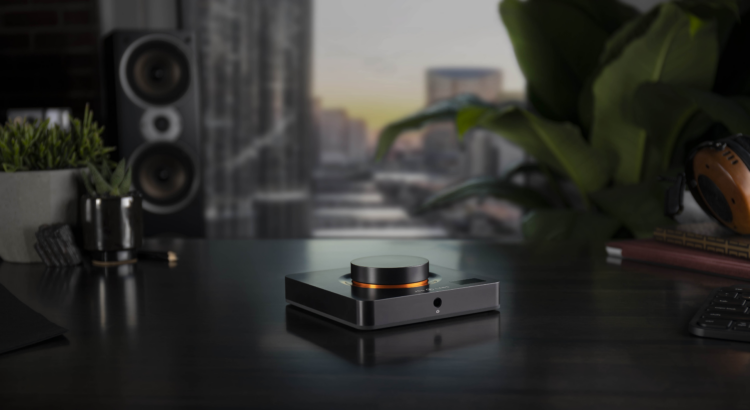
This is notably the approach used by the JDS Labs Element IV available from Cool Kids Audio.
The principle is simple:
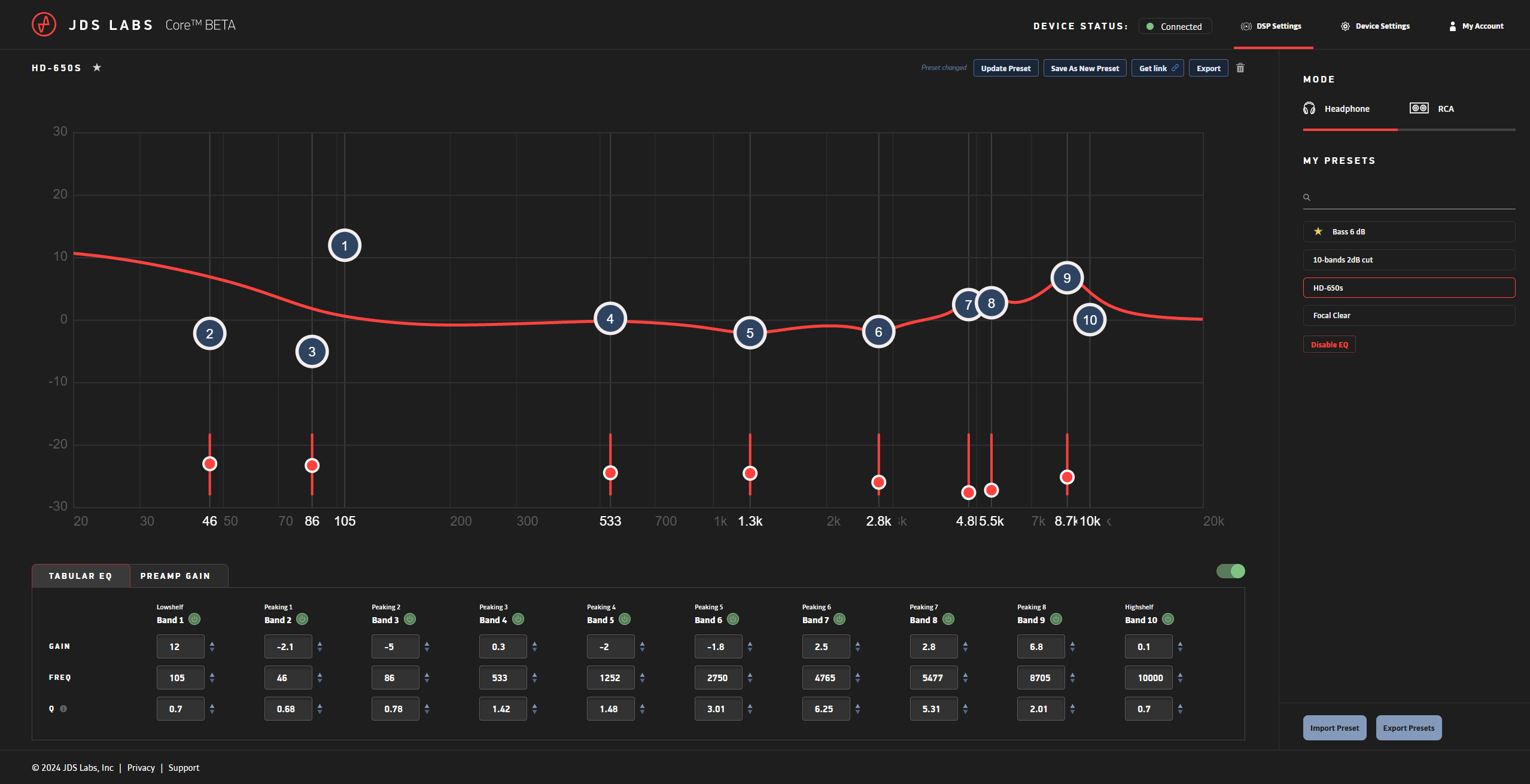
EQ presets are stored directly in the device.
Why this is interesting for daily use
In practice, hardware DSP offers several very concrete advantages.
A simpler experience
No need to:
-
restart software
-
check if the DSP is active
-
reconfigure EQ after a device change
The system becomes much more transparent.
Presets remain active everywhere
The EQ continues to function even if you change:
-
computer
-
operating system
-
streamer
-
console
-
USB source
Behavior remains consistent from one device to another.
A more "appliance" approach
The DAC functions more like a standalone hi-fi appliance than a peripheral dependent on a computer.
This is particularly interesting in:
-
living room setups
-
minimalist systems
-
multi-source installations
-
clean and simple desktop configurations
Modern DACs are becoming true audio platforms
For a long time, a DAC was simply a digital-to-analog converter.
Today, some models integrate:
-
DSP
-
parametric EQ
-
user profiles
-
mobile control
-
advanced volume management
-
independent channel processing
The firmware v2.1.0 of the JDS Labs Element IV perfectly illustrates this evolution with:
-
independent left/right DSP
-
more EQ bands
-
new volume control functions
-
zero-crossing improvements
Audio devices are progressively becoming evolving software platforms.
Does hardware DSP completely replace software EQ?
Not necessarily.
Software EQ often remains preferable for:
-
advanced studio work
-
complex convolution
-
experimental processing
-
professional workflows
-
very advanced users
But for everyday use, hardware DSP becomes extremely appealing:
-
simpler
-
more consistent
-
more universal
-
less system-dependent
And above all, it finally allows you to take your audio corrections with you, regardless of the computer used.
A logical evolution of modern audio
With the democratization of parametric EQs and headphone measurements, users now expect greater flexibility from their audio devices.
Hardware DSP perfectly meets this evolution:
-
simplicity
-
stability
-
portability of settings
-
multi-source compatibility
The future of high-end DACs is no longer solely about the chip used or measured performance, but also about the software experience and the evolvability of the devices.
Discover the product: JDS Labs Element IV