

Eversolo
Eversolo DAC-R8
Eversolo DAC-R8
In stock
Couldn't load pickup availability
Desktop R2R DAC, preamplifier and headphone amplifier
The DAC-R8 is the first Eversolo converter to drop the off-the-shelf DAC chip in favour of a conversion architecture developed in-house, built around discrete precision resistors. A single chassis holds that converter, a preamplifier with analogue R2R volume control and a 1 W headphone amplifier, alongside a full DSP stage and an in-house OCXO clock. It is designed to sit at the centre of a desktop or monitoring system, between your digital sources and a power amplifier or active speakers.
OriginR2R: conversion engineered by Eversolo
OriginR2R is a network of discrete precision resistors driven by an FPGA, which handles digital filtering and switching timing. Conversion is segmented into 5+20 bits: a 5-bit section covers the large steps of the signal, a 20-bit section the fine detail. The structure is fully differential, with the + and − paths separated from the very first resistor network, and the signal is buffered at the output by an OPA1612.
DSD gets its own native 1-bit path, feeding the resistor network directly without any conversion to PCM — though PCM and DSD do share the same network at the final stage. On the clock side, an in-house 10 MHz OCXO works alongside a PLL, and a 50 Ω BNC input accepts an external 10 or 25 MHz clock, including the Eversolo C10 master clock.
Analogue R2R volume and preamplifier duties
Volume control is a fully balanced analogue R2R network using precision resistors switched by relays: no digital attenuation anywhere in the chain, so resolution stays intact at any listening level. That lets the DAC-R8 drive a power amplifier or active speakers directly, with no preamplifier in between.
Two analogue inputs, a balanced stereo XLR and an unbalanced RCA, let you use it as a preamplifier for analogue sources. Manufacturer figures quote, on the 5 Vrms XLR output, THD+N of 0.000316 %, noise below 1.9 µVrms and 130 dB A-weighted SNR; on the 2.5 Vrms RCA output, 0.000355 % THD+N and 127 dB SNR. These are Eversolo's own measurements and have not been independently verified.
Full DSP, controlled from a browser
On-board processing covers a parametric EQ, a 20-band EQ, FIR filters, dynamics adjustment, per-channel delay, independent left/right adjustment and stereo balance. Conversion offers three modes — NOS without oversampling, OS at ×2, ×4 or ×8, and BEST — plus six digital FIR filters, enough to tailor filtering behaviour to the material.
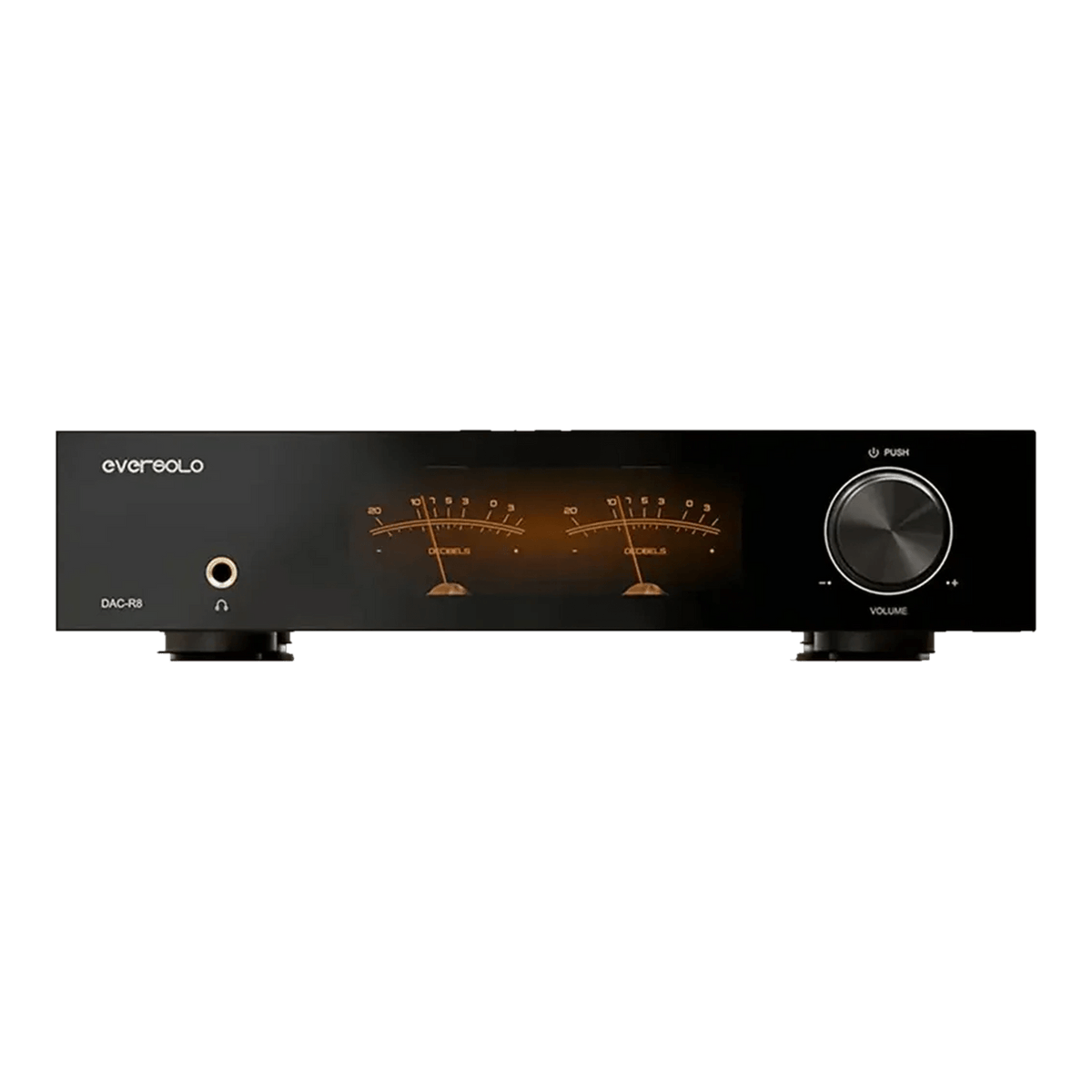
All of it is controlled from a web interface opened in a browser over the USB-B connection, with no driver and no software to install: nothing to deploy on a workstation. The Eversolo Control app and the supplied remote round out the controls, while the 5.2" IPS touchscreen on the front panel shows VU meters, a spectrum analyser, active input, sample rate, conversion mode and volume, with a rotary knob dedicated to level.
Connectivity and system integration
The asynchronous USB-B and the I²S-over-HDMI input, with eight selectable pinout modes, reach 32-bit/768 kHz PCM and accept DSD512. AES/EBU and coaxial S/PDIF, both galvanically isolated, along with Toslink optical, accept 32-bit/192 kHz and DSD64 over DoP; an HDMI eARC/ARC input takes TV sound in 24-bit/192 kHz stereo. Bluetooth 5.4 runs on a Qualcomm QCC3095 module with aptX, aptX HD and aptX Adaptive. The DAC-R8 has neither Wi-Fi nor Ethernet: this is not a network player.
Outputs: balanced XLR at 5 Vrms, unbalanced RCA at 2.5 Vrms and a 6.35 mm front-panel jack fed by its own drive circuit. The headphone amplifier offers three gain settings (2.5 / 5.5 / 7 Vrms) with automatic impedance detection, delivering 1 W into 16 and 32 Ω and 160 mW into 300 Ω, for a recommended range of 16 to 300 Ω. A 12 V trigger output and a dedicated grounding terminal ease integration. The CNC-machined black aluminium chassis matches the dimensions and industrial style of the Eversolo T8 network transport, which it is designed to stack with; it joins the DAC Series alongside the DAC-Z10, which uses AK4191 and AK4499 chips instead.
Specifications
- Conversion architecture: OriginR2R, discrete precision resistor network (no off-the-shelf DAC chip), 5+20-bit segmentation, FPGA-driven (digital filtering and switching timing), fully differential structure (+ and − paths separated from the first network), dedicated native 1-bit DSD path feeding the network directly, OPA1612 analogue output buffer
- Clocking: in-house 10 MHz OCXO with PLL; external clock input on BNC, 10 MHz or 25 MHz, 50 Ω (compatible with the Eversolo C10 master clock)
- USB-B: PCM 32-bit/768 kHz, native DSD512
- I²S over HDMI: PCM 32-bit/768 kHz, DSD512
- AES/EBU: PCM 32-bit/192 kHz, DSD64 over DoP
- Coaxial S/PDIF: PCM 32-bit/192 kHz, DSD64 over DoP
- Toslink optical: PCM 32-bit/192 kHz, DSD64 over DoP
- HDMI eARC/ARC: 24-bit/192 kHz stereo
- Digital inputs: 1× asynchronous USB-B, 1× I²S over HDMI (8 selectable pinout modes), 1× AES/EBU (galvanically isolated), 1× coaxial S/PDIF (galvanically isolated), 1× Toslink optical, 1× HDMI eARC/ARC, 1× BNC external clock input, 1× USB-A reserved for firmware updates
- Wireless: Bluetooth 5.4, Qualcomm QCC3095 module, aptX / aptX HD / aptX Adaptive codecs
- Analogue inputs: 1× balanced stereo XLR, 1× unbalanced stereo RCA (analogue preamplifier function)
- Analogue outputs: 1× balanced XLR 5 Vrms, 1× unbalanced RCA 2.5 Vrms, 1× 6.35 mm front-panel headphone jack with dedicated drive circuit
- Not provided: no 4.4 mm Pentaconn output, no 4-pin XLR, no Wi-Fi, no Ethernet
- Other: 12 V trigger output, dedicated grounding terminal
- Headphone amplifier: 3 gain settings (low/medium/high) at 2.5 / 5.5 / 7 Vrms, automatic impedance detection; 1 W into 16 Ω, 1 W into 32 Ω, 160 mW into 300 Ω; recommended impedance range 16 to 300 Ω; THD+N 0.000287 % and SNR 127 dB at high gain
- Volume control: fully balanced analogue R2R, precision resistors switched by relays, no digital attenuation; can drive a power amplifier or active speakers directly
- Conversion modes: NOS (non-oversampling), OS (×2, ×4, ×8), BEST; 6 digital FIR filters
- DSP: parametric EQ, 20-band EQ, FIR filters, dynamics adjustment, per-channel delay, independent per-channel adjustment, stereo balance
- Control: browser-based web interface over USB-B (no driver or software to install), Eversolo Control app, remote supplied
- Manufacturer figures, XLR preamp output: 5 Vrms, THD+N 0.000316 %, noise < 1.9 µVrms, SNR 130 dB A-weighted, dynamic range 130 dB, channel separation −142 dB
- Manufacturer figures, RCA preamp output: 2.5 Vrms, THD+N 0.000355 %, noise < 1.6 µVrms, SNR 127 dB, dynamic range 127 dB
- Frequency response: 20 Hz–20 kHz ±0.25 dB in BEST mode
- Display: 5.2" IPS touchscreen (VU meters, spectrum analyser, active input, sample rate, conversion mode, volume), rotary volume knob
- Chassis: CNC-machined aluminium, black
- Dimensions and weight: 315 × 230 × 75 mm including feet (65 mm without feet), 4 kg
- Power supply: linear, custom O-core transformer, 100-240 V 50/60 Hz, 32 W consumption
- Supplied with: remote, power cable, trigger cable, manual
- Note: THD+N, SNR, dynamic range and separation figures are manufacturer measurements, not independently verified